October 31, 2026


TL;DR
Soil stabilization turns weak or swelling soil into ground that can carry load. A binder such as lime or portland cement gets mixed in, or a geosynthetic and better-graded stone add structure. Lime suits plastic clay. Cement suits sandy, low-plasticity soil. Geosynthetics suit soft subgrade under aggregate.
Numbers here are typical ranges from federal and industry guidance. On a real project, the lab mix design governs.
Soil stabilization fixes four common job site problems: subgrade too soft or wet to carry equipment, clay that swells and shrinks with moisture, low bearing strength under pavement or slabs, and fines that pump up into the base.
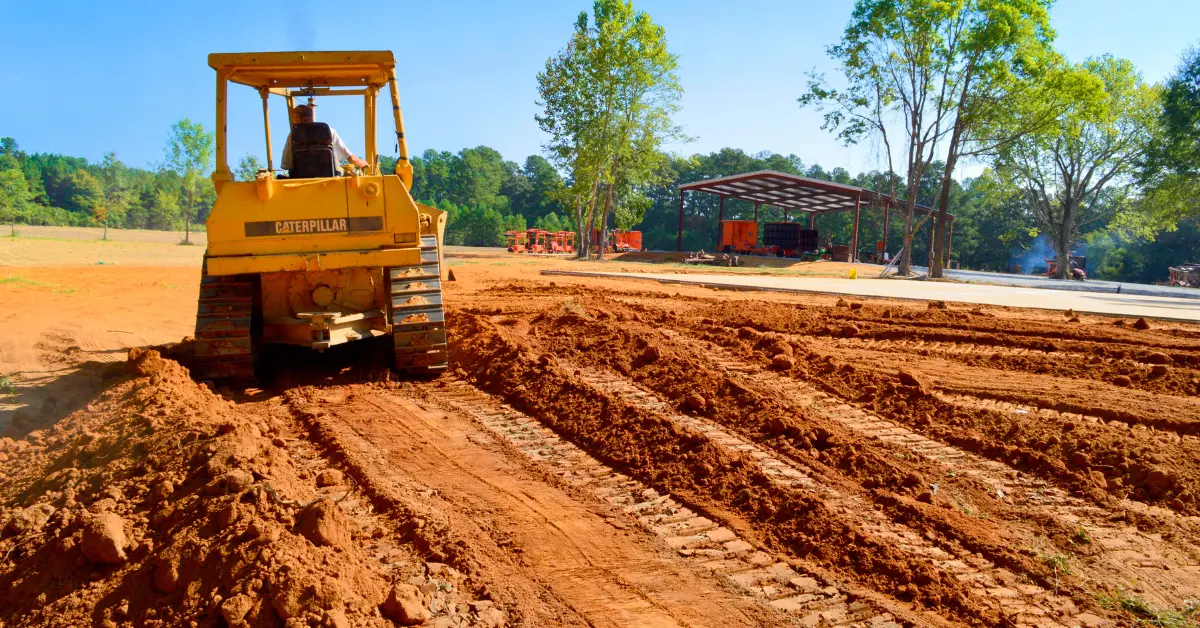
The tri-service manual UFC 3-250-11 (2020) lists the usual gains as better gradation, lower plasticity index (PI) or swell, and more strength and durability. It also names a working platform for construction as a use. After a week of rain, a superintendent with a pad of wet clay has a choice. Wait for sun, undercut and import select fill, or treat the clay in place.
Two terms get mixed up. Modification is a fast change in workability, and the National Lime Association (NLA) says it may or may not be permanent. Stabilization is a long-term strength gain proven on cured, soaked specimens. Foundations raise the stakes, as Soil Connect's note on clay fill under foundations explains: soil under a footing has to hold its volume through wet seasons and dry ones.
The main soil stabilization methods are lime, portland cement, fly ash blends, bitumen or polymer binders, and mechanical methods such as geosynthetics and gradation blending. Gradation and plasticity decide the shortlist.
Table: Common stabilizers and the soils they suit
| Method | Best-fit soils | What it does | Typical guidance |
| Lime | Clays and clayey gravels, PI of 10 to 12 or more, 25% or more passing No. 200 | Dries, cuts PI and swell, gains strength over weeks | 3 to 8% of dry soil weight (FHWA) |
| Portland cement | Sands, gravels, low-plasticity silts and clays | Binds grains into a hard layer within days | 3 to 10% for granular soils (FHWA) |
| Lime-fly ash blends | Coarse soils with few fines, PI under 25 | Fly ash supplies the pozzolan the soil lacks | Ratio set by the mix design |
| Bitumen or polymer | Sands and gravels, under 30% fines, PI under 10 | Binds grains and sheds water | Not effective against freeze-thaw (UFC) |
| Geotextile or geogrid | Soft subgrade under aggregate | Separates layers and restrains stone | AASHTO M 288 classes |
Inputs come from tests most geotech reports already include: a sieve analysis, Atterberg limits (ASTM D4318) and classification (ASTM D2487). The UFC 3-250-11 stabilization criteria run those results through a gradation triangle to a list of candidate stabilizers. Cutoffs differ by soil and agency. For cement, the UFC allows a PI up to 30 in coarse soils but wants a PI under 20 and a liquid limit under 40 in fine-grained soils, and FHWA's pavement manual says cement mixes properly only below a PI of 20. Treat any one threshold as a screen.
Organics and sulfates can rule a binder out early. The UFC caps organic content at 2 percent by weight and bars cement, lime and fly ash on its own pavements above 0.1 percent (1,000 ppm) sulfate. That military criterion is far stricter than the lime industry guidance below.
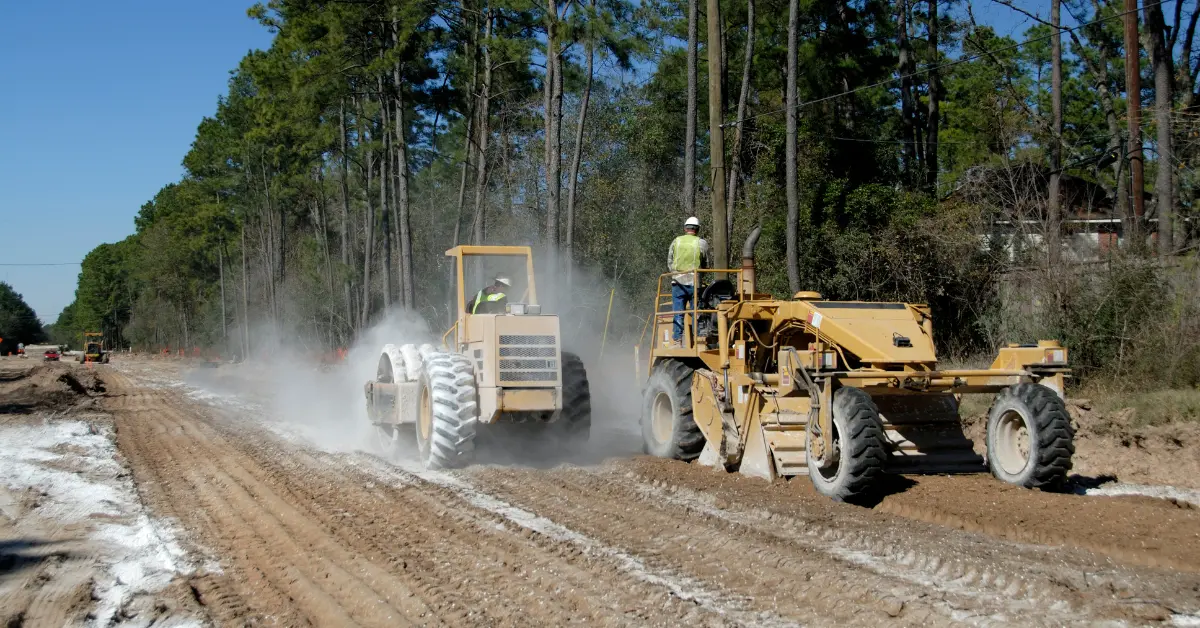
Lime stabilization works on clay. Calcium from the lime crowds onto the clay particles within hours, the PI drops and the soil turns friable. Over weeks, the high pH frees silica and alumina that bond into a cemented layer.
NLA's mix design brief screens candidates at a PI of 10 or more with at least 25 percent passing the 75 micron (No. 200) sieve. The dose starts with the Eades-Grim pH test, ASTM D6276: the lowest lime percentage that brings the soil-lime mix to a lab pH of 12.4 is the minimum for stabilization. Cured, soaked strength specimens then confirm it. Soil Connect's guide to plasticity index & soil type covers the soil science behind those limits.
Table: Typical lime rates by purpose (percent of dry soil weight)
| Purpose | Typical lime | Source |
| Drying a wet site | 1 to 4% | NLA technical digest |
| Working platform (modification) | 1 to 3% hydrated lime | FHWA NHI-05-037 |
| Road foundation stabilization | 3 to 6% | NLA technical digest |
| Clay stabilization | 3 to 8% | FHWA NHI-05-037 |
NLA adds that construction specs typically carry 0.5 to 1.0 percent more lime than the lab number, to cover field pulverization and variability.
UFC 3-250-11 defines expansive soil for pavement work as soil that swells more than 3 percent, and it flags a liquid limit above 60 with a PI above 35 as high swell potential. Lime is sized to bring swell under 1 percent, and 2 to 3 feet is generally the deepest layer treated in place. A lime content that lowers PI does not always stop swell, so swell tests follow. Wikipedia's expansive clay overview covers the minerals involved.
Water comes first.
The UFC says to remove or divert the water feeding the swelling zone before sizing a treatment. Treat clay that keeps getting wet from below and the lime layer fails early.
Sulfate heave: Sulfates in soil or groundwater can react with lime and clay to form ettringite, which FHWA says has a volume more than 200 percent larger than its constituents. NLA's sulfate memorandum treats total soluble sulfate under 3,000 ppm as low concern. From 3,000 to 8,000 ppm the risk climbs from moderate to high, and the work needs lime slurry, extra water and at least 72 hours of mellowing. Above 8,000 ppm it is too risky for routine work. Those limits assume a 10-to-1 water-to-soil extraction (TxDOT Tex-620-J), so confirm the lab's method before ordering lime.
Heavy clay often needs two-stage mixing. UFC 3-250-11 describes a first mix, a moist mellowing period of 24 to 48 hours or more with clods under 2 inches, then final mixing and compaction to at least 95 percent of ASTM D698 density for subbase.
Cement stabilization suits granular and low-plasticity soils. Portland cement hydrates and binds the grains quickly, so cement mixes are judged on strength at 7 days, where lime mixes wait for 28.
The Portland Cement Association (PCA) describes soil cement as a highly compacted mix of soil, portland cement and water. Dose sets the result. A small amount gives cement-modified soil with lower plasticity. More cement gives fully hardened soil cement. FHWA's pavement manual puts cement stabilization of granular soils at 3 to 10 percent of dry soil weight, reaching at least 150 psi within 7 days.
Table: Starting cement contents from UFC 3-250-11, Table 3-2
| USCS soil class | Initial estimate (% of dry weight) |
| GW, SW | 5 |
| GP, GW-GC, GW-GM, SW-SC, SW-SM | 6 |
| GC, GM, SC, SM, SP and similar dual classes | 7 |
| CL, ML, MH | 9 |
| CH | 11 |
Treat those as starting points. Lab moisture-density tests (ASTM D558) run at the estimate and 2 points either side, then 7-day specimens are broken for strength (ASTM D1633) and put through wet-dry or freeze-thaw cycles (ASTM D559 or D560). Whichever is the lowest cement content to pass both becomes the design.
PCA notes that soil cement needs no mellowing, so depending on its size a site can often be finished in a day. Speed is also required: the UFC wants cement mixes compacted as soon as possible, never placed at 40°F or below, and protected from freezing for 7 days.
A cement treated base makes sense when granular or low-PI soil is on site, loads are heavy, and the schedule cannot wait a month for lime. PCA lists building pads, ports, warehouses, truck terminals and parking areas as common uses, plus full-depth reclamation, which grinds an old asphalt road into new CTB.
For military pavements, UFC 3-250-11 requires a cement-stabilized base to reach 750 psi at 7 days under flexible pavement and 500 psi under rigid pavement. State and commercial specs set their own numbers. Then come the catches:
Chemical soil stabilization covers any additive that changes how soil grains bond or hold water. Past lime and cement, the common products are fly ash, kiln dust, chlorides, polymer emulsions and enzymes, and their track records differ widely.
Byproducts are where the cost case gets interesting. The UFC notes fly ash is used to cut the lime or cement a mix needs, so a local source can lower the binder bill. Soil Connect's article on soil stabilization with industrial waste covers how they lower plasticity. For any proprietary product, ask for independent test data on a similar soil, then run the same strength and durability tests a lime mix would face.
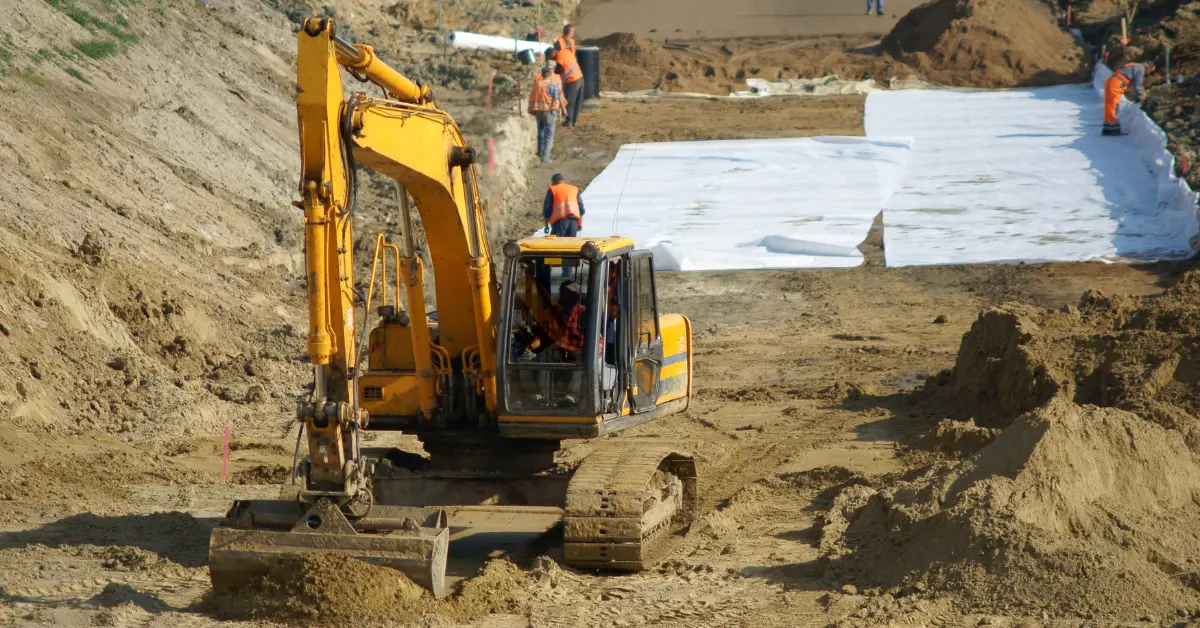
Mechanical stabilization improves soil by physical means: compaction, blending in better-graded aggregate, or placing a geogrid or geotextile fabric between soft subgrade and the stone above it. Nothing has to react, so there is no cure period.

FHWA's Geotechnical Aspects of Pavements manual splits the jobs. Geotextiles work best as separators and filters. A geogrid is better at reinforcing, since it interlocks with the stone and resists the sideways shoving that becomes ruts. On its own, a grid does not stop soft subgrade from pumping into the base, so it gets paired with a geotextile or a separator subbase.
Subgrade strength sets the label. In FHWA's subgrade stabilization guidance, based on AASHTO M 288, geotextiles or geogrids with a designed aggregate thickness provide stabilization on soft, wet subgrades with a CBR below 3. At a CBR of 3 or more, a geotextile counts as separation. FHWA's design steps cut the extra aggregate needed to offset mixing at the subgrade by 50 percent with a geosynthetic, then keep the greater of that and the platform thickness construction traffic needs. The pavement section itself does not get thinner.
Aggregate still does the structural work, as Soil Connect explains in how aggregate affects site stability. Mechanical methods make sense on haul roads that must work right away, on subgrade too wet to mix to depth, and on high-sulfate clay that rules out calcium-based binders.
The cheapest way to stabilize a site is usually to fix the water problem first, then treat only the area and depth that need it, with the binder or fill closest to the job.
Working out how to stabilize soil on a budget starts with the soil report, not a product sheet.
Estimators can rough out binder tonnage before quotes come back. Take a 12-inch treated depth and a dry unit weight of 110 lb per cubic foot. One square yard then holds 990 lb of dry soil. At 5 percent lime, that is about 50 lb per square yard, or roughly 248 tons for 10,000 square yards. Swap in the lab's unit weight and dose.
Frequently asked questions
It can be, when the clay reacts. Lime stabilization of soil needs enough lime and reactive clay to form the cementing compounds NLA describes as permanent. Lower-dose modification improves workability within hours but may not last. FHWA lists the threats: sulfate heave, calcium leaching, which is worse at low lime contents, and carbonation, which ample lime, good compaction and proper curing limit.
It depends on the product, the dose and the job, and no current public price list covers it reliably. A soil stabilizer such as lime or cement is bought by the delivered ton, and the tonnage comes from treated area, depth and the mix design percentage. Add the lab mix design, spreading and rotary mixing, water, testing and cure time. Compare local quotes at the lab's dose against the cost of undercut and imported fill.
It can, when the native soil reacts and passes the mix design, since treating in place skips trucking dirt out and back in. It is a poor fit for organic soil, high-sulfate clay or a schedule that cannot wait for a cure. Then importing is safer. Soil Connect's Find Dirt service matches projects with nearby sites that have excess dirt, and its Dirt Pros check the dirt against project specifications. Undercut spoil can leave through Get Rid of Dirt.
Plan on days in the field and weeks to months for full strength. Heavy clay usually mellows 24 to 48 hours between mixes, and up to 7 days with high sulfates. Some specs then require a 3 to 7 day undisturbed cure, while others allow paving over an undamaged layer. The UFC judges lime strength at 28 days and notes reactions slow sharply when soil stays below 60°F.
Keep reading
When treating in place will not work, fill out the Find Dirt form and a Soil Connect Dirt Specialist will contact you within 1 business day.