

October 23, 2026


Quick answer
Road base is dense-graded crushed aggregate that runs from a 1 1/2 to 2 inch top size down to dust. Rolled at the right moisture, it locks into a hard layer that carries trucks. Clean gravel has almost no fines, so water drains through it fast but the stone stays loose. Build driveways, pads and roads on road base, and save gravel for drains and top dressing.
In road base vs gravel, the deciding difference is fines. Road base keeps the sand and dust a crusher produces, and those small particles fill the gaps between stones so the layer compacts into a dense mat. Clean gravel, the kind sold for drainage work, is screened or washed until almost nothing fine is left.
North Carolina's NCDOT standard specifications show what road base looks like on a gradation sheet. All of it passes the 1 1/2 inch sieve, 35 to 55 percent passes the No. 4, and 4 to 12 percent is fine enough to pass the No. 200. NCDOT also limits the plasticity index of the fraction passing the No. 40 sieve to 4, with extra checks up to 6 and rejection above that, which keeps plastic clay out.
Under NCDOT's conventional density method, each layer is compacted to at least 100 percent of the AASHTO T 180 density, the modified Proctor test, before the next one goes down. The finished base has to be "smooth, hard, dense, unyielding and well bonded."
Clean stone is sized to leave its voids open. NCDOT's #57 passes the 1 1/2 inch sieve, but no more than 5 percent of it gets through the No. 8, and the spec lists it for shoulder drains and sediment control stone.
With no fines, nothing holds the pieces in place. Penn State's aggregate primer says open-graded stone drains effectively but does not compact well into a dense mass. Rounded natural gravel is worse under a tire, because the FHWA gravel roads manual finds broken stone resists movement under load better than rounded, natural-shaped stone.
In the FHWA manual, base gravel means the cushion layer under a paved road, with a larger top size and very little clay. The manual warns that this material will not form a crust as an unpaved driving surface. Gravel roads need a separate surface gravel with plastic fines that bind.
Soil Connect's piece on how aggregate affects site stability covers the same ground across a whole site.
Names for road base material change at state lines. Order by spec section and gradation, never a yard's label.
Table: Four state specs sold as road base, plus the clean stone they get mixed up with. Fines are percent passing the No. 200 sieve, except #57, which is limited at the No. 8.
| | Top size | Fines | Spec use |
| ABC (NCDOT) | 1 1/2 in | 4 to 12% | Base course |
| Class 5 (MnDOT 3138) | 1 1/2 in | 3 to 10% | Base |
| 21A (VDOT Sec. 208) | 2 in | 6 to 12% | Aggregate base |
| Crusher run No. 25 (VDOT Sec. 205) | 1 1/2 in | Not set | Pipe bedding |
| #57 stone (NCDOT) | 1 1/2 in | 0 to 5% | Drains |
ABC stone is short for aggregate base course, the label NCDOT uses throughout its spec. The spec allows crushed stone, crushed gravel or uncrushed gravel, limits the minus No. 40 fraction to a liquid limit of 30, and lets a base up to 10 inches thick go down in one compacted layer.
Class 5 gravel is a Minnesota base class, written into MnDOT Spec 3138 in the 2025 standard specifications. Despite the word gravel, it is dense graded, with 3 to 10 percent passing the No. 200, or up to 12 for 100 percent crushed quarry rock. Virgin material needs at least 25 percent crushed particles. Recycled concrete and asphalt are allowed, with a (C) or (B) added to the designation.
Crusher run causes the most confusion. Virginia defines it in VDOT Section 205 as aggregate holding all the sizes produced as rock passes through a series of crushers, and writes it for bedding and backfilling pipe and box culverts, maintaining traffic and all-weather private access pavements. Its grading stops at the No. 4 sieve. Base under Virginia pavement is a separate item, Section 208 size 21A or 21B, with limits down to the No. 200, so confirm which one the plans call for.
Crushed concrete can meet the same specs. NCDOT accepts it as ABC when it meets the ABC gradation and came through a crushing facility, with the liquid limit raised 5 points to no more than 35. VDOT permits it as crusher run but bars it from subsurface drains with perforated pipe and from base work that uses geotextile fabric.
ard's label.
A dense gradation is what carries a truck. Fines packed between the stones, plus a density test on every lift, give a layer that spreads wheel loads instead of shoving. Typical base course on paved roads is 4 to 6 inches thick and compacted to at least 95 percent relative compaction, says the entry for base course on Wikipedia. The soil under it sets the thickness a job really needs.
Open voids move water, and that is the whole job in a French drain. Penn State notes well-graded mixes are not suitable for drainage, so keep road base out of any trench meant to carry water.
FHWA's archived recycled materials guideline reports a lower compacted unit weight than mineral aggregate, so each ton covers more volume. On large reconstruction jobs, crushing old concrete on site can cut aggregate hauling. The catch is tufa, a white precipitate from unhydrated cement and free lime that has clogged subdrains and blinded geotextile filters on some projects. Per FHWA, the problem is not universal.
Clean stone on a drive surface stays loose. Even good surface gravel, the FHWA manual says, carries some loose float.
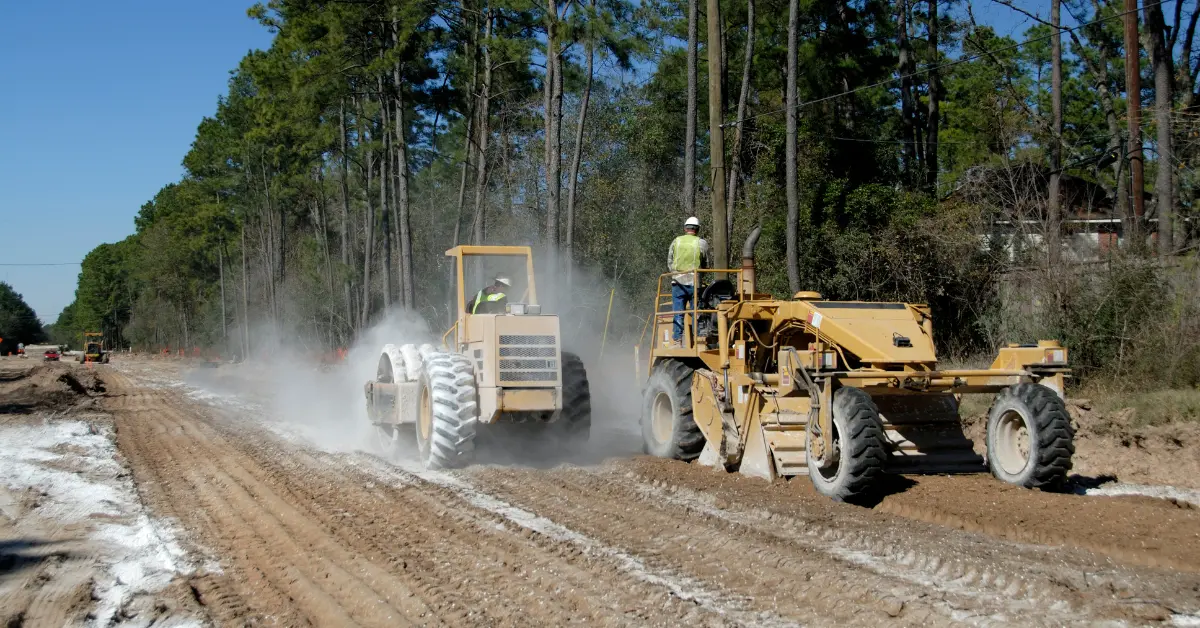
Placement asks more of the crew. NCDOT compacts road base near the moisture that gives maximum density and places it with a spreader box to limit segregation. Soil Connect's construction aggregate FAQs add that excess moisture lowers load-bearing capacity, while too little hinders compaction.
A lasting gravel base for driveway and pad work is road base below, with a thin coat of clean stone on top if the owner wants the look and accepts some loose stone.
Order a dense-graded base to the state spec your plans name, such as ABC, class 5 or 21A, and compact it in lifts to the density in the specs.
Use clean stone with no fines, such as #57, and keep road base out of the drain.
Crushed concrete that meets the same gradation earns its place on yield. Keep it out of perforated pipe drains and off geotextile fabric, as VDOT requires, unless the engineer signs off.
Start with the closest qualified source, since Soil Connect's matching looks for shorter haul distances. Post the job to find road base nearby. A Soil Connect Dirt Specialist contacts you within 1 business day, and Dirt Pros check the material against your project specifications.
Get the gradation, plasticity limit and density target in writing first. Soil Connect's list of material specs before ordering covers the rest.
Frequently asked questions
Multiply length by width by compacted depth in feet and divide by 27. A 10 by 40 foot driveway at 4 inches of compacted base comes to about 4.9 cubic yards. At MoDOT's preliminary factor of 0.058 tons per square yard per inch, that is roughly 10.3 tons. Confirm your supplier's unit weight before ordering.
It is the compacted layer of crushed stone, crushed gravel or similar aggregate between the subgrade or subbase and the pavement. Graded from a 1 1/2 or 2 inch top size down to fines, it compacts into a stable layer. North Carolina calls it ABC, Minnesota specifies class 5, and Virginia uses 21A or 21B. FHWA cites AASHTO M 147 and ASTM D2940 as national base aggregate specs.
It often is, once it has been properly processed and tested. FHWA's guideline says crushed concrete is 100 percent crushed, locks up well and has generally performed satisfactorily in granular base. NCDOT accepts it as ABC when it meets the ABC gradation. The risk is drainage, because tufa from unhydrated cement and free lime has clogged subdrains, so VDOT bars it from perforated pipe drains and from base work that uses geotextile fabric. Ask the supplier for gradation test results.
Delivered prices vary too much by market for one number. As a national reference, USGS estimates the 2025 average unit value of US crushed stone at $18.50 per metric ton, about $16.78 per short ton, up from $13.26 per metric ton in 2021. Trucking comes on top, so compare delivered quotes from the closest qualified sources.
Keep reading
Post your road base or gravel order and a Soil Connect Dirt Specialist will contact you within 1 business day.